
Among the Sensex firms, IndusInd Bank, Tata Steel, Tata Motors, Sun Pharma, Infosys, Mahindra & Mahindra, Infosys, NTPC, Bharti Airtel, HCL Technologies and Axis Bank were the biggest gainers. Tech Mahindra and Bajaj Finance were the laggards.

The US Fed has also retained its benchmark rates for the Federal funds in the range of zero to 0.25 per cent, as part of its efforts to help in boosting the economy. After its two-day monetary policy meeting, which ended on Wednesday, the Fed said that 'economic activity is leveling out'.

Investors' wealth has tumbled by over Rs 5.82 lakh crore in three days of market decline. Feeble global cues, foreign fund outflows and concerns over policy tightening by central banks have led to the selling pressure, experts said. Declining for the third straight session on Monday, the 30-share BSE benchmark Sensex nosedived 1,023.63 points or 1.75 per cent to close at 57,621.19. In three days, the benchmark has tanked 1,937.14 points.

Higher interest rates in the US do not necessarily coincide with capital outflows.

Even if the central bank doesn't pull the trigger later, it is still expected to by the end of the year.

Indian government bonds, particularly those of shorter maturity, strengthened sharply on Monday, as the collapse of the California-based Silicon Valley Bank (SVB) prompted investors to rush to the safety of American debt, leading to a decline in US bond yields.

Benchmark equity indices climbed nearly 1 per cent on Wednesday on buying in HDFC Bank and Reliance Industries. Investors are eyeing the two important events lined up ahead -- the interim budget and the US Fed interest rate decision -- to derive further cues from. Recovering all the early lost ground, the 30-share BSE Sensex jumped 612.21 points or 0.86 per cent to settle at 71,752.11.

The US Federal Reserve has announced to maintain its bond purchase tapering programme.

'We are confident that over the next few years the government will strike a fine balance between populist measures and growth, and manage coalition partners well.'

'Investors with higher risk appetite and longer horizon (more than one year) can invest in longer-duration funds like corporate bond funds, long-duration funds and gilt funds for maximum gain.'

Nearly 40 per cent of IITians sitting for placements in 2024 are yet to receive job offers, showing a doubling of the 'unplaced' in the last three years from 19 per cent in 2021-2022 to 38 per cent in 2023-2024.
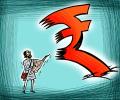
Indian rupee, which earlier this week touched an all-time low, is likely to remain under pressure and may test new levels as a fallout of the US Federal Reserve indicating more interest rate hikes, experts said. The aggressive rate hikes will dampen demand and increase the possibility of a recession in the US. This could accelerate the pace of capital outflows, weaken the rupee and raise the threat of imported inflation.

RBI has, since January, cut its policy rate four times.

The July-September quarter GDP numbers are due on November 30.
From the Sensex basket, Tech Mahindra, Tata Steel, JSW Steel, HCL Technologies, Tata Consultancy Services, Larsen & Toubro and Kotak Mahindra Bank were the biggest laggards. Mahindra & Mahindra, Power Grid, Bajaj Finance, IndusInd Bank and Maruti were the major gainers.

Among the Sensex firms, Infosys, Tech Mahindra, HCL Technologies, Tata Consultancy Services, Wipro and JSW Steel were the major gainers during the morning deals. Nestle, Bharti Airtel, Axis Bank ITC were among the laggards.

Foreign portfolio investors' (FPIs') net investments in the domestic debt market surged in December, marking a 77-month high, that is, since July 2017. According to market participants, this significant uptick in FPI inflows can be attributed to the post-domestic policy outcome and the US Federal Reserve's dovish stance at the December policy. FPI inflows into debt stood at Rs 18,393 crore in December against Rs 14,106 crore in November, according to data on the National Securities Depository Limited.

'Recent underperformance notwithstanding, equities should constitute a major part of investors' financial portfolio.'

Brinda examines some alarming aspects of religious fanaticism through the narrative engine of a well-oiled serial killer mystery, observes Arjun Menon.

The frequent use of these assault rifles by terrorists in Jammu and Kashmir, according to experts, is a consequence of the US Army leaving behind arms and ammunition while pulling out from Afghanistan in 2021 and is a cause of concern due to the more lethal nature of the steel bullets used.

'The main worry is lots of new investors coming into the markets in order to make a quick buck/easy money.' 'Those things are happening again and have happened in the past as well.' 'All that has led to problems.' 'We are not there yet, but will get there eventually.'

He said cheap valuations, improving sentiment and the ongoing reform momentum coupled with increased transparency due to the internet are driving investors to the Dalal Street.

'We expect the bull-market phase to still persist, but now led by large-caps which offer better valuation and benefit from FII inflows.'
'We expect continued pressure on midcaps, but any sharp correction looks unlikely from here on.'

The next policy meeting will be in mid-June, when the panel will be joined by Stanley Fischer, the former Bank of Israel governor whose nomination to the Fed's board was confirmed on Wednesday by the US Senate.
From the Sensex firms, Bajaj Finance, HDFC, HDFC Bank, Bajaj Finserv, Asian Paint, State Bank of India, Tata Consultancy Services, Bharti Airtel, Reliance Industries and Tata Steel were the biggest gainers. HDFC climbed 2.59 per cent after the housing finance major on Thursday reported a 20 per cent growth in standalone net profit to Rs 4,425 crore for the quarter ending March 2023 on the back of higher interest income. IndusInd Bank, Nestle, Power Grid, ITC, Tata Motors and Mahindra & Mahindra were the major laggards.

'It makes sense to have gold in one's portfolio keeping the political and economic risks of 2024 in mind.'

Wipro was the biggest loser in the Sensex pack, slipping nearly 2 per cent, followed by IndusInd Bank, State Bank of India, Kotak Mahindra Bank, ICICI Bank, HDFC Bank, Infosys, Tata Consultancy Services, HDFC and Bajaj Finserv. On the other hand, Nestle, Mahindra & Mahindra, ITC, HCL Technologies, Asian Paints and Maruti were among the gainers.

The nomination would put Yellen on course to be the first woman to lead the institution.

Trends in the global markets, trading activity of foreign investors and announcement of domestic macroeconomic data are the major factors that would drive investors' sentiment in a holiday-shortened week ahead, analysts said. Benchmark indices had a record-breaking rally in the past week driven by impressive GDP data. Equity markets would remain closed on Friday for Mahashivratri.

Some Manchester United fans had previously urged Musk on Twitter to consider buying the club

'If the Maha Vikas Aghadi thinks that they have won 30 (Lok Sabha) seats and that would translate to winning 180 assembly seats they would be living in a fool's paradise.'

The US Federal Reserve has said economic activity is improving while deciding to continue with the near-zero interest rate regime to bolster the economy.

Top laggards in the Sensex pack included IndusInd Bank, Bajaj Finance, ITC, UltraTech Cement and HDFC Bank, while Sun Pharma, Tech Mahindra, M&M and Asian Paints ended with gains.

'A soft landing of the Indian economy would be a long-term positive for the equity markets.'

Among the Sensex firms, Larsen & Toubro, UltraTech Cement, JSW Steel, Titan, Bajaj Finance, Wipro, Tech Mahindra and Nestle were the major laggards. Maruti, Power Grid, Axis Bank, State Bank of India, NTPC, HDFC Bank, ITC and IndusInd Bank were the gainers.
There are more near-term global draggers in store for the domestic stock market, as the central banks across the US, Japan and Europe are likely to further hike their benchmark interest rates
The US Federal Reserve on Tuesday cut interests rates by 0.75 points from 3 per cent to 2.25 per cent. The cut initially disappointed markets which had risen sharply on hopes of a 1 percentage point cut. The decision was taken by eight votes to two. First quarter earnings at the two Wall Street firms fell less than analysts had expected, easing concerns about the state of the investment banking sector.

Analysts remain bullish on the road ahead for the equity markets, but warn against volatility on account of domestic and global cues. The upcoming Lok Sabha elections back home and the interest rate trajectory of the US Federal Reserve, they said, will be the two most important factors that the markets will keep a tab on. That apart, the valuation of the Indian markets, they feel, will also be eyed in context of how global peers are performing.
The central bank also left the benchmark rates unchanged in the range of 0 to 0.25 per cent. The Federal Open Market Committee which decides on the key rates has retained the same near zero and said economic conditions warrant 'exceptionally low levels' of federal fundsfor a longer period.
 © 2026 Rediff.com - Advertise with us - Disclaimer - Privacy Policy - Sitemap - Feedback - About us - Terms of use - Grievances